Wednesday, 6 April 2016

Coal Prices Slump with Asian Demand

Coal price hopes fade amid reality of slowing Asia demand: Russell


- Coal's bright start to the year in Asia is fading amid the gloom of weak demand across the region's top importers and still too much supply from top producers.

The benchmark Newcastle weekly coal index ended at $51.13 a ton on April 1, down from its high so far this year of $52.59, reached on March 11.

That peak capped a rally of 11 percent from the almost 10-year low of $47.37 a ton plumbed in the week to Jan. 21, but it now appears it was nothing more than a false dawn.

Coal was most likely the beneficiary of better sentiment towards commodities in general that saw strong rallies in iron ore and crude oil in recent weeks, which have also petered out.

But while there may be some positive fundamentals in other commodities markets, with tentative signs of a recovery in China's vast manufacturing sector, there is no silver lining in sight for coal.

China's official Purchasing Managers' Index expanded for the first time in 9 months in March, rising to 50.2, up from February's 49 to be just over the 50-line that demarcates expansion from contraction in the manufacturing sector.

While this may herald better times ahead for sectors such as iron ore, steel, aluminum, copper and crude oil, the joy is unlikely to be shared by coal.

China aims to keep the rise in its total energy use to just 0.9 percent in 2016, the same rate as 2015, the National Energy Administration said on April 1.

For coal, the important part is that the plan also calls for coal's share of that total to be cut to 63 percent from last year's 64 percent.

If a cut of 1 percentage point doesn't sound that significant, its worth noting that China's total energy consumption is about 4.34 billion tonnes of coal equivalent, meaning 1 percentage point is about 43.4 million tonnes.

While the lower coal consumption is most likely to result in lower domestic output, if it was taken from imports, it would amount to roughly one-fifth of 2015's total imports of 204.06 million tonnes.


China plans to shut 60 million tonnes of domestic coal output this year, and 500 million tonnes in total over the next five years.

However, this isn't necessarily bullish for imports, as even cuts of this magnitude will still leave sufficient domestic coal to meet demand, leaving imports to compete on a price basis in specific markets, particularly those in China's industrial southeast.

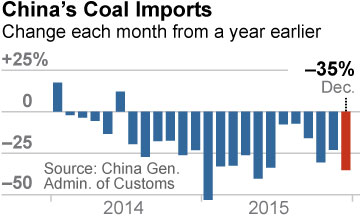
In the first two months of this year, China's coal imports have dropped 10.2 percent, a slower rate of decline than the almost 30-percent decline experienced in 2015.

But a look at the details show major coal exporters Australia and Indonesia are struggling to ship the fuel to the world's top buyer.

Imports from Australia are down almost 18 percent in the first two months from the same period a year ago, while those from Indonesia have slumped 21.7 percent.

The surprise winner in China so far this year has been North Korea, which has boosted its shipments to its neighbor by 26.9 percent and is now just behind Indonesia as the third-biggest supplier.

As with anything to do with North Korea, there is possibly a political element in these purchases, but no matter the motivation the fact remains that China's main suppliers are being squeezed by a competitor they know very little about.


IMPORTS DOWN IN TOP BUYERS
Outside of China there is little reason for coal exporters to be optimistic, with imports by No.2 buyer India still trending lower despite a modest uptick in February.


India imported 16.79 million tonnes in February, up 1.7 percent from the same month a year ago and the first increase in eight months.

But given that state producer Coal India has recently had to scale back mining activity as consumption growth has been weaker than supply growth, it's likely that the trend toward lower imports will persist.

Japan's total coal imports rose 1.2 percent in February from a year earlier, but purchases by the third-ranked importer were down 1.9 percent for the first two months of the year.

South Korea, Asia's fourth-biggest coal importer, saw its overseas purchases drop 17.6 percent in February from a year earlier, and they are down 6.5 percent for the first two months of the year.

With purchases down in the first two months of the year in Asia's four-biggest importers, it's clear that there is no demand justification for a sustained price rally in coal prices.

Image result for coaL  PRODUCTIONThere are some longer-term positives for coal in the region, such as the start of construction of a 2,000-megawatt coal-fired plant in Indonesia and plans for more new units in countries such as Japan.

But these are several years away from coming on line, meaning coal exporters have to deal with the current weak market while hoping for future growth in demand.

Indonesia remains the main adjuster of market balance, with output in the Southeast Asian nation expected to drop to about 350 million tonnes in 2016 from 391 million, according to the energy ministry.

The industry expects exports to fall to less than 300 million tonnes this year from 330-360 million tonnes last year, as mines remain under pressure from low prices.

Australia's coal shipments also appear to be easing, with Newcastle Port, the world's largest coal-export harbor, reporting 24.72 million tonnes of coal exported in the first two months of the year, a 5.7-percent drop from the same period in 2015.


The overall picture from the coal sector is one of weak demand from importers, and continuing supply adjustments from exporters.

While this rules out any price rally, it may allow for prices to stabilize assuming exporters continue to adjust supply to balance the market.


(Editing by Joseph Radford)


Tuesday, 5 April 2016

Today's ENERGY News - April 5, 2016


Top Stories 

Canada’s Ever-Shrinking Oil Industry Braces


 for More Job Cuts

After almost two years of sinking oil prices and at least 40,000 job cuts, Canada’s petroleum industry still isn’t finished tackling its bloated operations. The next round of layoffs has already begun with Cenovus Energy Inc. and Murphy Oil Corp. announcing workforce reductions last week. Ongoing cuts by Suncor Energy Inc., Encana Corp. and others will likely result in thousands more jobs lost by the end of the year as the Canadian industry shaves billions worth of spending in order to continue operating in one of the world’s most expensive oil-producing regions. “It will probably take another six months before some of the bloated staffing levels are tackled,” said Todd Hirsch, chief economist at ATB Financial in Calgary. “Many of these companies are getting employment levels down to the bare bones and over the spring and summer there will be more layoffs.” Crude that averaged about $90 a barrel […]

U.S. Utilities’ Natural-Gas Hedges Turn Sour

Experts don’t know how exactly much money utilities have lost nationwide on natural-gas hedges. Natural-gas prices have plunged 74% in the past 10 years, but some U.S. utilities haven’t reaped the full benefit because of bad bets they made to hedge the cost of the fuel. Utilities that distribute natural gas or burn it to make electricity often enter into hedging contracts as a form of insurance to protect themselves and their customers against wild variations in the fuel’s price. The derivatives contracts don’t represent actual fuel deliveries. Rather, if gas prices go up, utilities make profits on the contracts that help offset their higher fuel costs. If gas prices go down, they lose money on the contracts but still benefit by paying less for their fuel. But in Florida, four utilities including the state’s largest, Florida Power & Light Co., suffered net losses of $6 billion on their […]

Risk of Once-in-100-Year Drought Means One More India Rate Cut

The risk India will suffer below-average monsoon rain for a third year, a once-in-a-century event, probably means the central bank has room for just one interest-rate cut before an extended pause. Thirty-five of 39 economists surveyed by Bloomberg see the Reserve Bank of India lowering the repurchase rate to 6.5 percent from 6.75 percent on Tuesday, one predicts no change while three forecast a reduction to 6.25 percent. The median estimate in a separate survey shows the benchmark will drop to 6.50 percent this quarter and to 6.25 percent in the October-December period and stay there till at least June 2017. Two years of back-to-back drought have meant India’s reservoirs are three-quarters of the past decade’s average. Water scarcity could hurt crops, worsen price pressures and dent growth in Asia’s third-biggest economy. RBI Governor Raghuram Rajan would also be wary of the recent recovery in oil prices that could […]

Kuwait says hopes for OPEC, non-OPEC oil coordination

Kuwait hopes that coordination among oil producers inside and outside OPEC will help to stabilize the market, acting oil minister Anas al-Saleh told reporters on Sunday. “As long as there is coordination among major producers in OPEC and outside OPEC, that will certainly help stabilize prices,” he said. Saudi Arabian Deputy Crown Prince Mohammed bin Salman said on Thursday that Riyadh would not join an output freeze without the participation of Iran and other major producers, Bloomberg reported. A meeting to discuss the production freeze has been scheduled in Doha on April 17. Asked on Sunday whether Kuwait’s position was the same as the Saudi stance, Saleh said: “We have announced our position before: we will attend the meeting and see. We think that a consensus is […]

Another Western intervention in Libya looms


The shaky debut last week of a new unity government in Libya brings Western nations, including the United States, much closer to a renewed military mission there, and to a host of obstacles that will test their ability to secure a country gripped by Islamist extremism and civil war. Tensions ran high on Wednesday after Fayez Serraj, a little-known Libyan technocrat selected as prime minister in a United Nations peace process, arrived by boat in Tripoli from Tunisia. Western officials hailed his installation in the Libyan capital as a sign that the country’s two-year political divide is finally coming to an end — despite the existence of rival governments in Tripoli and the country’s east. The United States and European allies, including Italy, France and Britain, have […]


Monday, 4 April 2016

Electric Cars Leading the Conversion


We Need to Electrify As Much Transportation As We Can 


Transcript:

JESSICA DESVARIEUX, PRODUCER, TRNN: Welcome to the Real News Network. I'm Jessica Desvarieux in Baltimore.
Folks are lining up to reserve electric car automaker Tesla's Model 3. It's considered to be one of the first electric cars for the mass market at an expected price tag of 35 thousand dollars. Tesla's CEO, Elon Musk, will be unveiling the vehicle on Thursday evening, so we can't show you what it will actually look like. But in this segment we wanted to get beyond the consumerism and ask, will this be a game changer for the automobile industry in America and the environment?
Now joining us to help us answer that question is Richard Heinberg. He's a senior fellow at the Post Carbon Institute. Thanks so much for joining us, Richard.
RICHARD HEINBERG: It's a pleasure, Jessica.
DESVARIEUX: So, Richard, why has it taken so long for an affordable electric car to sort of come to the market? I'm reminded of the 2006 documentary "Who Killed the Electric Car?" which really highlights how we essentially went from having electric cars on California roads in the '90s to then, eventually, shredding and destroying those very same vehicles years later. So my question to you, Richard, is, who killed the electric car?
HEINBERG: Well, the bosses at the Detroit automakers decided back in the 1990s that there wouldn't be a mass market for the electric car because of the short range of the vehicles. They thought consumers wouldn't buy a car if it didn't have a two to three hundred mile range, and the batteries at that time were not capable of delivering that kind of range. So even though they built some prototypes and sent them out to drivers, they never produced a mass market car.
Image result for tesla model 3
Today, battery technology has improved enough so that it is possible to produce an electric car for the masses with at least a 200-mile range, and that's what's anticipated for the Tesla Model 3.

DESVARIEUX: Okay. there are some folks that are saying that this isn't as big of a game changer as people are making it out to be, because essentially you're getting power to charge your electric vehicle from fossil fuel sources like coal. Do you agree with that?
HEINBERG: Not entirely. First of all, the energy mix is different in different parts of the country. Some parts of the country, electricity is mostly coming from coal. In other parts of the country the mix is more oriented toward natural gas, hydro and renewables. So, first of all, it depends on where you're getting your electricity from.
And second, you know, if you look out at the energy transition that we're just beginning right now, away from fossil fuels toward renewables, it's clear that one of the main strategies that we'll have to pursue during this energy transition is electrification. Right now only about 20 percent of the final energy that we use in the United States is in the form of electricity. The rest is in the form of liquid fuels for transportation, energy for high heat industrial processes and so on.
We have to electrify as much of that energy usage as we can, because most of our renewable sources of energy produce electricity. That's true of solar and wind, geothermal and hydro power. So we need to electrify as much transportation as we can.
DESVARIEUX: Okay. You have some automakers, you know, really touting this as a bright future, that we're going to see more and more electric cars hit the market. I want to ask you about the role of cheap oil. Do you think that threatens he growth of the electric car industry?
HEINBERG: Well, probably not over the long run. We're headed toward electric cars one way or the other, I think. However, over the short run it definitely takes some wind out of the sails, because from the consumer's standpoint the biggest draw for an electric car is that over the lifetime of ownership the operating costs are much lower, so if you have cheap gas that changes that differential a bit, so that there's not as much of an advantage.
DESVARIEUX: Okay, let's talk about the future. What would a truly green transportation system look like, and are there some states or countries that are really laying out a road map to get us there?
HEINBERG: Well, a truly green transportation system probably wouldn't rely on electric cars that much because it wouldn't be relying on cars that much. Cars are an inherently inefficient mode of transportation. I mean, think about it. Most cars just have a driver and maybe one passenger, and meanwhile you're dragging around two tons of metal, glass and plastic in order to get those one or two people where they want to go.
Much more efficient modes of transportation are light rail, any kind of public transportation, actually. So what we really need is to build up more rail transport and get people walking and bicycling as much as possible.
DESVARIEUX: Okay. Richard Heinberg, thank you so much for joining us.
HEINBERG: It's been a pleasure. Thanks, Jessica.
DESVARIEUX: And thank you for joining us on the Real News Network.
DISCLAIMER: Please note that transcripts for The Real News Network are typed from a recording of the program. TRNN cannot guarantee their complete accuracy.

Image result for real news network


Zurich Partners and PRIVATE Community

Zurich Partners and PRIVATE Community
The Edge For Leading International, Regional and Local Insights

Blog Archive